

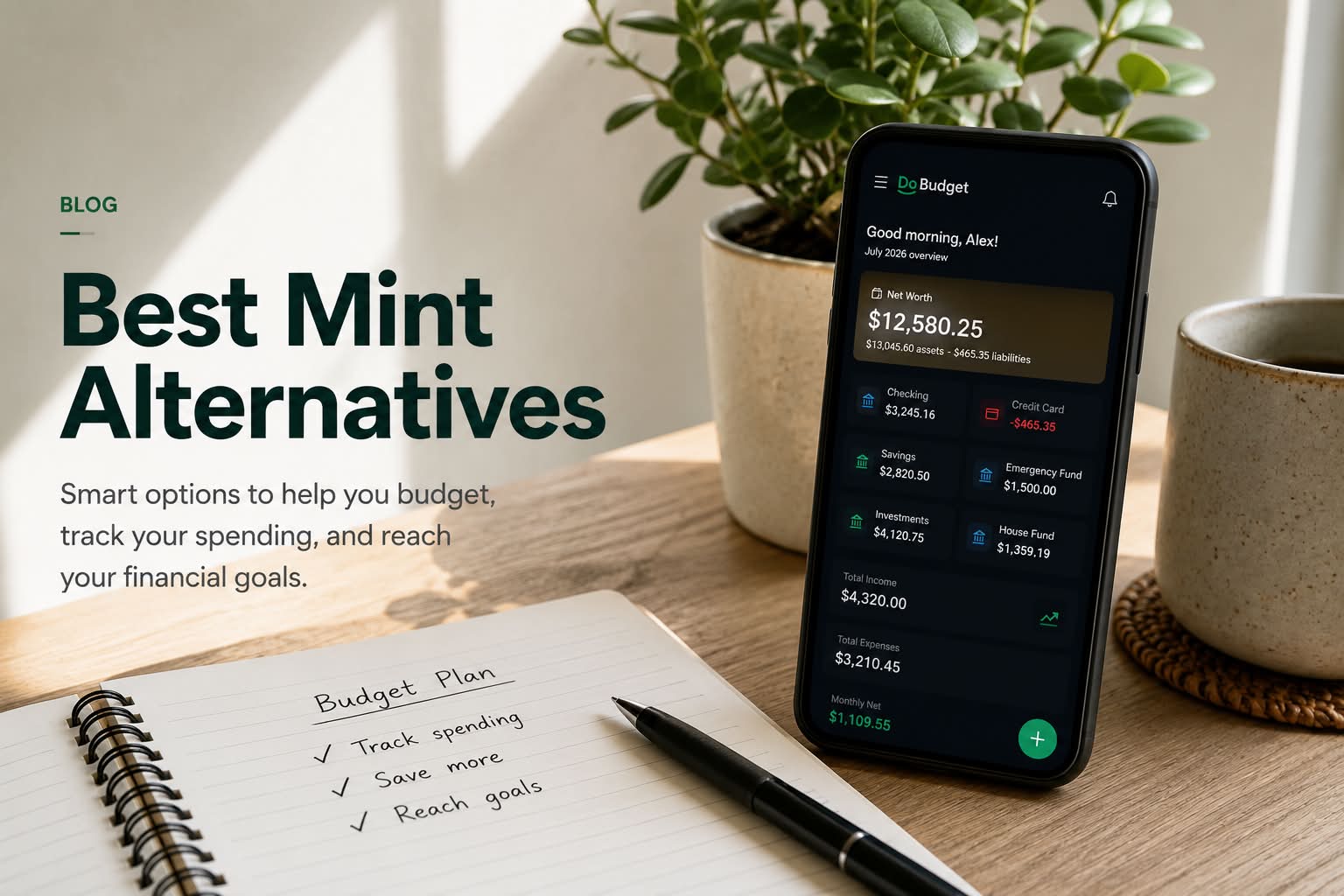
When Intuit shut Mint down, millions of people learned an uncomfortable lesson: a free app can disappear, along with a decade of your financial history. The apps competing to replace it have taken two very different lessons from that — some doubled down on bank-synced automation at a premium price, others went the opposite way entirely.
Full disclosure up front: we make Do Budget, one of the apps on this list. We’ll tell you exactly where it fits and where it doesn’t.
First, decide what you actually miss about Mint
Mint refugees usually fall into one of three camps:
- “I miss seeing everything automatically.” You want bank sync and a full net-worth dashboard, and you’re willing to pay for it.
- “I miss having a budget that told me when I was overspending.” The dashboards were nice, but what you actually used was the budget and the alerts.
- “I miss free.” Fair — but after Mint, it’s worth asking how a free finance app pays its bills. Usually the answer involves your data or aggressive product placements.
Knowing your camp makes the choice easy.
The main alternatives
Monarch — the premium Mint successor
Monarch is probably the closest thing to “Mint, but paid and polished”: bank sync, net worth, shared access for couples, investment tracking. It costs about $99/yr as of this writing. If you’re in camp 1 and the price doesn’t sting, it’s a strong pick.
YNAB — the methodology
YNAB is less a Mint replacement than a different religion: zero-based envelope budgeting, where every dollar gets a job. Devoted community, excellent teaching content, bank sync included — around $109/yr. Great if you want to change how you think about money, overkill if you just want spending alerts. We wrote a full Do Budget vs. YNAB comparison if you’re weighing that one.
Copilot — the pretty one (Apple only)
Beautifully designed, AI-assisted categorization, roughly $95/yr — and only on iPhone and Mac. If you’re on Android or want to budget from any browser, it’s off the table.
Rocket Money — the bill negotiator
Popular for finding and cancelling subscriptions. Its budgeting features are thinner, and pricing is “choose what you pay” with premium features gated. Better as a cleanup tool than a daily budgeting home.
Spreadsheets — the free option that actually respects you
Honestly? A spreadsheet is a legitimate Mint alternative. It’s free, private, and infinitely flexible. The catch is that you build and maintain everything yourself — the reminders, the charts, the discipline to open it. Most people’s budget spreadsheet has a last-modified date three months old.
Do Budget — the affordable, private one (that’s us)
Do Budget is for camp 2, and priced for people who noticed that camp 1’s options all cost $95–110 a year: it’s $4.99/mo or $49.99/yr.
The trade: there’s no bank sync — by design. You log spending in a few seconds or import your bank’s CSV export. In exchange, no third-party aggregator ever touches your bank credentials, and the app is built around keeping you engaged instead of automated: alerts at 80% and 100% of any budget, bill reminders the day before something’s due, savings goals that celebrate milestones, and a Sunday recap email that summarizes your week in 30 seconds. It works in English, French, and Spanish, handles multiple currencies, and installs as an app on your phone.
Who it’s not for: if manual entry is a dealbreaker, we’d genuinely point you at Monarch instead. An unused budgeting app is the most expensive kind.
The bottom line
| If you want… | Look at |
|---|---|
| Mint-style automation, price no object | Monarch |
| A complete budgeting method | YNAB |
| The prettiest app on iPhone | Copilot |
| To cancel forgotten subscriptions | Rocket Money |
| Free and private, DIY effort | A spreadsheet |
| Budgets, alerts, and goals for ~$4/mo, no bank login | Do Budget |
Whatever you pick, pick something. The real lesson of Mint’s shutdown isn’t which app to trust — it’s that the habit matters more than the tool, and any of these beats the “check your balance and wince” system.
Third-party prices are as of this writing; check each app’s site for current numbers. Do Budget offers a 14-day free trial — cancel before it ends and you won’t be charged.