

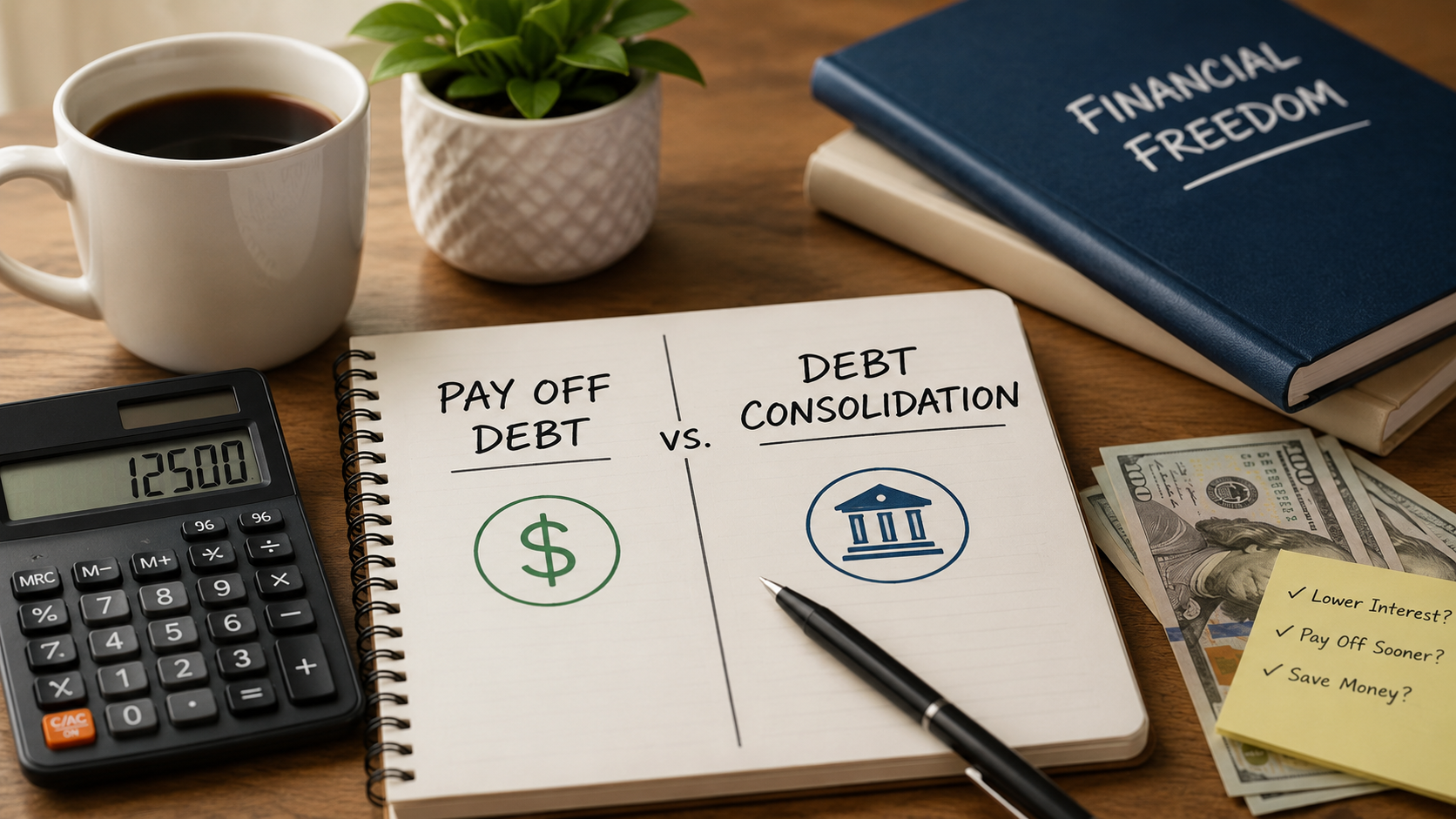
Debt Payoff vs. Debt Consolidation: Which Option Could Save You Thousands?
If you’re carrying credit card debt, personal loans, or a line of credit, you’ve probably asked yourself the same question I did.
Should I focus on paying off my debt faster, or would debt consolidation save me more money?
I used to think there was an obvious answer.
There isn’t.
After comparing different repayment scenarios, interest costs, and monthly payment amounts, I realized the best option depends entirely on your numbers, not someone else’s. What surprised me most was how much even small changes could affect the total cost of borrowing.
If you’re trying to become debt-free, here’s what I’ve learned.
I Thought Making the Minimum Payment Was Enough
Like many people, I assumed making the minimum payment meant I was doing everything right.
Technically, I was.
Financially, I wasn’t making much progress.
I’d make my payment every month, log back into my account a few weeks later, and wonder why the balance had barely changed. Once I looked at the interest charges, it finally made sense. Most of my payment wasn’t reducing the debt. It was paying the lender.
That was the moment I stopped looking at my monthly payment and started paying attention to the total cost of borrowing.
Why Minimum Payments Can Cost You Thousands
Minimum payments are designed to keep your account in good standing. They’re not designed to help you become debt-free quickly.
Take a high-interest credit card as an example.
Even if you’re making every payment on time, it can take years, or even decades, to pay off the balance if you’re only paying the minimum. During that time, interest continues to accumulate every single month.
One of the biggest surprises for me was seeing how much difference a few extra dollars each month could make.
Running different repayment scenarios, I found that adding an extra $100 or $200 each month often shortened the payoff timeline by years and saved thousands of dollars in interest.
It wasn’t a dramatic lifestyle change.
It was simply giving more of my payment toward the debt instead of the interest.
Looking at All My Debt Changed Everything
For a long time, I looked at each debt separately.
One credit card.
One loan.
One line of credit.
The problem was that I never saw the bigger picture.
Once I listed every balance, interest rate, minimum payment, and monthly payment in one place, I immediately saw which debt was costing me the most money.
The highest interest rate wasn’t always attached to the largest balance, but it was usually the one quietly costing me the most every month.
Having everything laid out made it much easier to decide where every extra dollar should go.
Is Debt Consolidation Worth It?
Debt consolidation can absolutely be a smart financial move.
It combines multiple debts into one loan, ideally with a lower interest rate and a single monthly payment.
On paper, that sounds like an easy decision.
In reality, it isn’t always.
One thing I noticed while comparing different scenarios was that a lower monthly payment doesn’t automatically mean you’ll spend less overall.
Some consolidation loans reduce your monthly payment by extending the repayment period. That can improve your cash flow, but it can also increase the total amount of interest you pay over the life of the loan.
I’ve also seen the opposite.
A lower interest rate with a reasonable repayment term can save thousands of dollars and help you become debt-free much sooner.
The lesson I took away was simple.
Never assume debt consolidation is the cheaper option.
Run the numbers first.
Should You Pay Off Debt Faster or Consolidate?
There isn’t one answer that works for everyone.
Paying extra each month often makes sense if:
- You can comfortably increase your monthly payments.
- Your interest rates aren’t extremely high.
- You want to avoid taking out another loan.
Debt consolidation may be worth considering if:
- You’re juggling several high-interest debts.
- You qualify for a much lower interest rate.
- Keeping track of multiple payments has become stressful.
The only way to know which option is better is to compare both scenarios using your own numbers.
Compare the Numbers Before You Decide
One thing I’ve learned is that guessing is expensive.
It’s easy to assume debt consolidation is the better option because the monthly payment looks lower. It’s just as easy to assume paying an extra $100 each month won’t make much of a difference.
Neither assumption is always true.
Running different repayment scenarios opened my eyes.
In some cases, increasing monthly payments by just a couple hundred dollars reduced the payoff timeline by years and saved tens of thousands of dollars in interest.
In other cases, debt consolidation produced the biggest savings because the lower interest rate outweighed everything else.
The point is that every situation is different.
A debt payoff calculator helps remove the guesswork by showing you exactly what each option will cost.
You can compare:
- How long it will take to become debt-free.
- Total interest paid.
- Interest saved by increasing your monthly payment.
- Whether debt consolidation actually reduces your borrowing costs.
If you’d like to compare your own numbers, try the free Do Budget Debt Payoff Calculator:
https://www.dobudget.com/blog/tools/debt-payoff-calculator
A few minutes of planning today could save you years of repayments.
Budgeting Made the Biggest Difference
Here’s something I didn’t expect.
Paying off debt wasn’t just about making bigger payments.
It was about understanding where my money was going every month.
Once I started tracking my spending, I found subscriptions I wasn’t using, impulse purchases I barely remembered making, and small expenses that added up far more than I realized.
None of those purchases were individually expensive.
Together, they were enough to make an extra debt payment every month.
That was probably the biggest lesson I learned.
A budget doesn’t just show you where your money went.
It helps you decide where you want your money to go.
Once I had that clarity, finding extra money for debt payments became much easier.
The Best Debt Payoff Strategy Is the One You Can Stick With
Some people become debt-free by aggressively paying off their highest-interest debt.
Others save money through debt consolidation.
Many use a combination of both.
There isn’t a perfect strategy.
There is only the strategy that works for your income, your goals, and your lifestyle.
The important thing is making decisions based on real numbers instead of assumptions.
Small changes made consistently over time often produce the biggest results.
Ready to See What Your Debt Could Really Cost?
Whether you’re paying off credit cards, a car loan, a line of credit, or several different debts, seeing the numbers can completely change how you approach repayment.
Try the Do Budget Debt Payoff Calculator to compare your current payoff timeline, test different monthly payment amounts, and see whether debt consolidation could save you money and help you become debt-free sooner.
https://www.dobudget.com/blog/tools/debt-payoff-calculator
While you’re there, explore Do Budget to track your spending, organize your bills, and build a budget that supports your debt payoff goals. Knowing where every dollar goes makes it much easier to free up money each month and stay on track.
Financial freedom doesn’t happen overnight. It happens one good decision at a time.
Less money stress. More money progress.